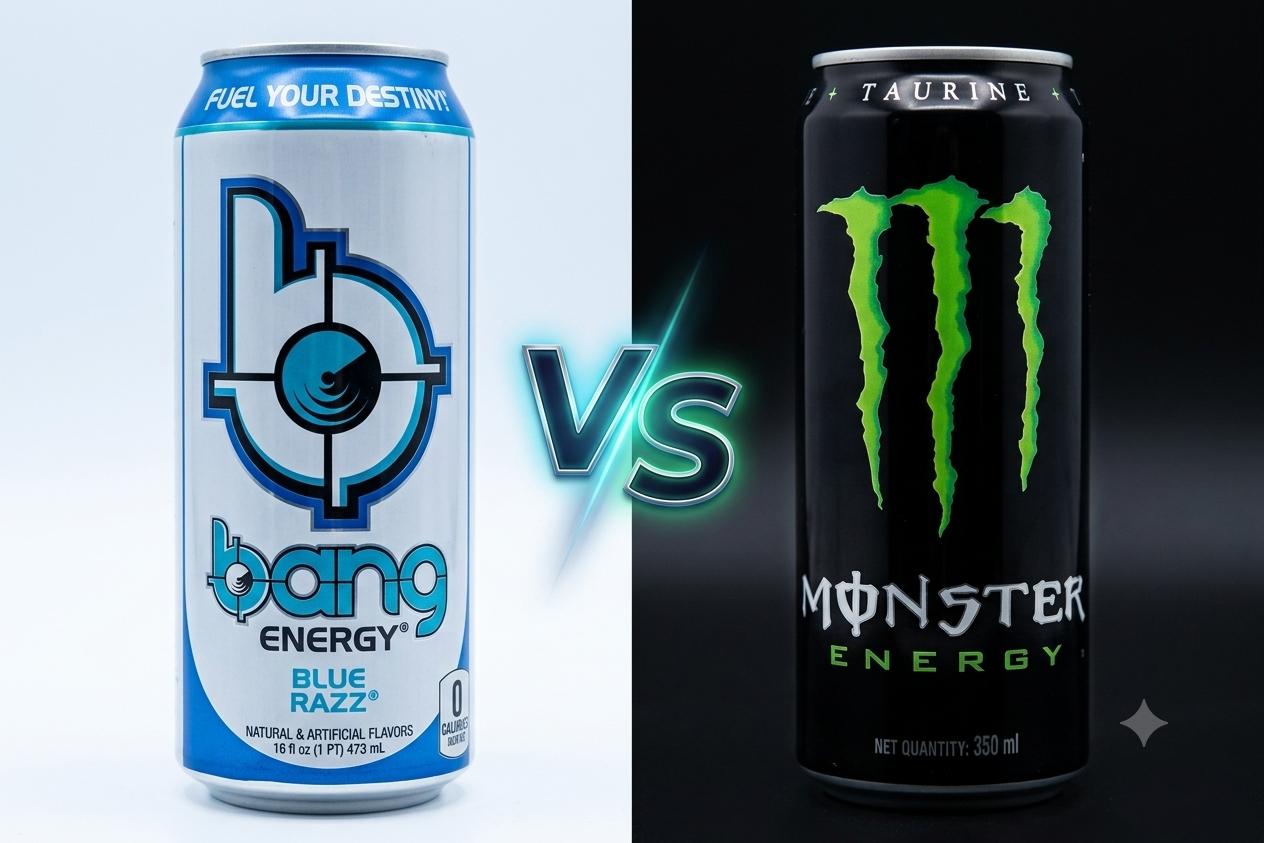
Most “Bang vs. Monster” comparisons stop at the same two facts: Bang has more caffeine, Monster has more sugar. Both are true and neither tells you much about which one actually fits your situation — or about the two things that make this comparison stranger than it looks: a nine-figure court verdict over one of Bang’s headline ingredients, and the fact that these two “competitors” have technically shared a parent company since 2023.
Quick Verdict
| Bang | Monster Original | |
|---|---|---|
| Caffeine (16 oz) | 300 mg | 160 mg |
| Sugar | 0 g | 54 g |
| Calories | 0 | ~210–230* |
| Sodium | Low (no listed daily-value amount) | 370 mg |
| Signature ingredients | Super Creatine®, EAAs, CoQ10 | Taurine, L-carnitine, panax ginseng |
| % of FDA’s 400mg/day caffeine guidance | 75% | 40% |
| Corporate parent (as of 2026) | Monster Beverage Corporation | Monster Beverage Corporation |
*Calorie counts for Monster Original run 210–230 across different retailer and flavor listings — check the specific can, since formulations vary slightly by market.
Caffeine: The Gap Is Real, and Dosing Puts It in Context
A 16 oz can of Bang carries 300 mg of caffeine. Monster Original carries 160 mg. That’s not a marginal difference — it’s roughly the gap between one strong coffee and one large coffee stacked on top of each other.
The more useful number isn’t the raw milligrams, though — it’s caffeine per kilogram of body weight, which is how sports-nutrition guidance is actually written. The International Society of Sports Nutrition’s position stand on caffeine cites roughly 3–6 mg/kg as the dose range associated with a measurable ergogenic (performance) effect. For a 70 kg (154 lb) adult, that’s 210–420 mg.
- Bang (300 mg) → ~4.3 mg/kg — solidly inside that performance-dosing range.
- Monster (160 mg) → ~2.3 mg/kg — below it, closer to a strong-coffee dose than a pre-workout dose.
Both sit comfortably under the FDA’s commonly cited 400 mg/day ceiling for healthy adults on their own — Bang at 75% of that daily allowance in one can, Monster at 40% — but that math changes fast if you’re also drinking coffee, tea, or a second can.
Sugar and Calories: The Actual Contrast
This part isn’t close. Bang is sugar-free and zero-calorie, sweetened with sucralose and acesulfame potassium. Monster Original carries 54 g of sugar and roughly 210–230 calories per can, plus 370 mg of sodium — none of which Bang’s label lists as a meaningful contribution.
If sugar is the deciding factor for you, the fairer matchup isn’t Bang vs. Monster Original — it’s Bang vs. Monster Zero Ultra, which drops the sugar and calories to bring the two much closer on this specific axis.
Ingredients: Where the Two Formulas Actually Diverge
Bang builds its formula around a stack of essential amino acids (including L-leucine, L-isoleucine, and L-valine), CoQ10, and its trademarked Super Creatine® — which is where this comparison gets more interesting than most labels let on (more below). The can also lists magnesium chloride and calcium chloride, but it’s worth being precise about what those are doing: independent ingredient analyses put the actual mineral content at trace, formulation-level amounts used for carbonation stability and mouthfeel, not a nutritionally meaningful source of either mineral. Meaningful magnesium supplementation research typically uses 350–500 mg/day — nowhere near what a can of Bang contributes.
Monster takes the more traditional energy-drink route: taurine, L-carnitine, panax ginseng root extract, and a B-vitamin blend, alongside its sugar-and-caffeine base. Taurine and ginseng are both long-studied in general energy-drink formulations, though the evidence for a standalone performance benefit at typical energy-drink doses is modest rather than dramatic — which is a fair description of most energy-drink “extras,” Bang’s included.
The Part Most Comparisons Skip: Super Creatine and the $293 Million Verdict
Bang has marketed Super Creatine (chemically, creatyl-L-leucine) as a muscle-building, performance-enhancing ingredient since the drink launched — and this claim has actually been tested in court, not just in the internet’s replies section.
In Monster Energy Co. v. Vital Pharmaceuticals, Inc. (No. EDCV18-1882 JGB, C.D. California), a federal jury found in September 2022 that Bang’s parent company had made false and deliberately misleading claims about Super Creatine, awarding Monster roughly $293 million in damages. The core issue: creatyl-L-leucine is not creatine monohydrate, the form of creatine with decades of research behind its muscle and performance benefits, and the jury found Bang’s marketing had implied otherwise.
That’s not a reason to write off everything else in Bang’s formula — the caffeine dose and EAA content are exactly what’s on the label — but it is a reason to treat the “Super Creatine builds muscle” pitch specifically with real skepticism rather than taking it at face value the way a lot of comparison content still does.
The Ownership Twist
Here’s the part that makes “Bang vs. Monster” a strange framing in 2026: Vital Pharmaceuticals, Bang’s parent company, filed for Chapter 11 bankruptcy in October 2023 — partly under the weight of that verdict — and Monster Beverage Corporation acquired the Bang Energy brand out of that bankruptcy. The two drinks you’re comparing on this page are now, corporately, siblings under the same parent company. It doesn’t change what’s in either can, but it’s relevant context that most “vs.” comparisons of these two brands still don’t mention, even in recently updated posts.
Safety Note
Both drinks are within the FDA’s general 400 mg/day caffeine guidance for healthy adults on their own, but caffeine is additive across everything you drink in a day — coffee, tea, other energy drinks, pre-workout supplements. Bang’s 300 mg leaves much less room for anything else before you approach that ceiling.
If you’re pregnant, caffeine-sensitive, managing a heart condition or anxiety disorder, or taking medications that interact with stimulants, talk to a doctor before making either one a regular habit — and avoid stacking multiple cans, or combining either drink with alcohol.
This is general product information, not medical advice.
Which One Actually Fits You?
- Want a genuine pre-workout dose of caffeine and don’t mind an artificially sweetened, zero-calorie drink: Bang’s 300 mg sits inside actual ergogenic dosing ranges.
- Want a lower, more moderate caffeine dose and don’t mind added sugar: Monster Original is the gentler option — or reach for Monster Zero Ultra if you want Bang’s zero-sugar profile at Monster’s lower caffeine dose.
- Specifically buying Bang for the Super Creatine claim: worth knowing what a federal jury actually found about that specific ingredient claim before making it your deciding factor.
- Caffeine-sensitive, or already drinking coffee today: Monster’s 160 mg leaves more daily headroom than Bang’s 300 mg.
FAQ
Does Bang or Monster have more caffeine? Bang, by a wide margin — 300 mg per 16 oz can versus Monster Original’s 160 mg.
Is Super Creatine actually creatine? No. It’s creatyl-L-leucine, a different compound from creatine monohydrate. A federal jury found in 2022 that marketing claims comparing it to creatine’s proven benefits were false and awarded Monster roughly $293 million in damages over it.
Are Bang and Monster made by the same company? As of 2023, yes at the ownership level. Monster Beverage Corporation acquired the Bang Energy brand after Vital Pharmaceuticals’ 2023 bankruptcy, though the two remain distinct product lines with different formulas.
Is 300 mg of caffeine safe in one can? For most healthy adults, yes, relative to the FDA’s general 400 mg/day guidance — but it uses up 75% of that allowance in a single can, leaving little room for coffee or other caffeinated drinks the same day.
Does Bang’s magnesium and calcium content matter nutritionally? Not meaningfully. Both are present at trace, formulation-level amounts rather than doses that would contribute noticeably to daily mineral intake.
Sources
- FDA, guidance on caffeine intake for healthy adults (commonly cited 400 mg/day reference)
- International Society of Sports Nutrition, position stand on caffeine and exercise performance (3–6 mg/kg ergogenic dosing range)
- Brand-published label and ingredient data, Bang Energy and Monster Energy (retailer-listed nutrition panels cross-checked across multiple sellers)
- Monster Energy Co. v. Vital Pharmaceuticals, Inc., No. EDCV18-1882 JGB (C.D. Cal.), jury verdict, September 2022
- Public reporting on Vital Pharmaceuticals’ 2023 Chapter 11 bankruptcy filing and Monster Beverage Corporation’s acquisition of the Bang Energy brand
