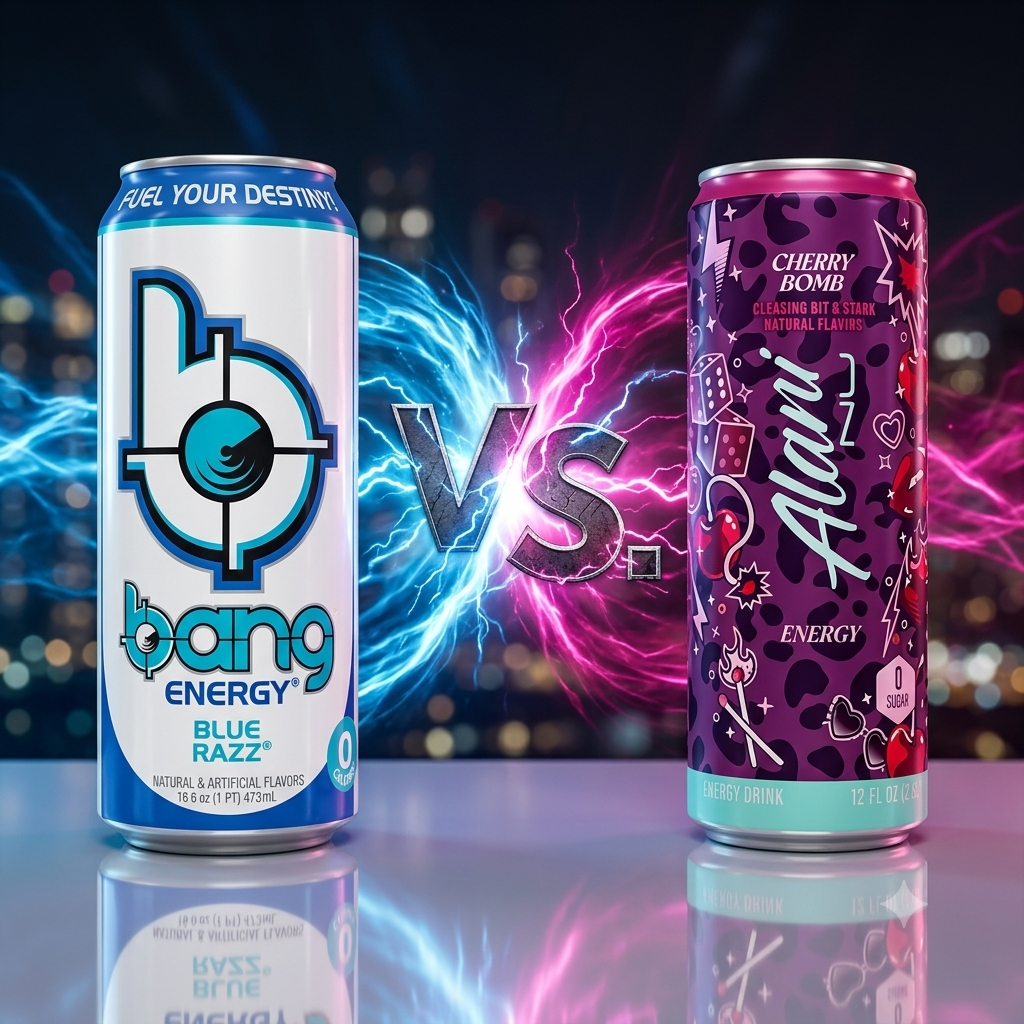
Most “Bang vs. Alani Nu” comparisons land on the same two lines: Bang has more caffeine, Alani Nu tastes better to more people. Both are true and neither explains which one actually fits your day — or the stranger fact sitting underneath this comparison: PepsiCo bet on one of these brands first, that bet blew up in a lawsuit, and PepsiCo’s money quietly ended up behind the other one instead.
Quick Verdict
| Bang | Alani Nu Energy | |
|---|---|---|
| Caffeine (per can) | 300 mg (16 oz) | 200 mg (12 oz) |
| Sugar | 0 g | 0 g |
| Calories | 0 | 10–15 |
| Sodium | Low (no listed daily-value amount) | ~190–200 mg |
| Signature ingredients | Super Creatine®, EAAs, CoQ10 | Taurine, L-theanine, panax ginseng |
| % of FDA’s 400mg/day caffeine guidance | 75% | 50% |
| Corporate parent (as of 2026) | Monster Beverage Corporation | Celsius Holdings |
| PepsiCo relationship | Former exclusive distributor (2020–2022, ended in litigation) | Distributed by PepsiCo as of 2025, via its stake in Celsius |
Caffeine: Both Are Real Doses, One More Than the Other
A 16 oz Bang carries 300 mg of caffeine. A 12 oz Alani Nu carries 200 mg. That’s a real gap, but both land in a range worth putting in context rather than just comparing raw numbers.
The International Society of Sports Nutrition’s position stand on caffeine cites roughly 3–6 mg/kg as the dose range associated with a measurable performance effect. For a 70 kg (154 lb) adult, that’s 210–420 mg.
- Bang (300 mg) → ~4.3 mg/kg — solidly inside that range.
- Alani Nu (200 mg) → ~2.9 mg/kg — also inside the range, just closer to the lower end.
Both sit under the FDA’s commonly cited 400 mg/day ceiling for healthy adults on their own — Bang using up 75% of that allowance in one can, Alani Nu 50% — but that math tightens fast if you’re also drinking coffee or a second can.
Sugar and Calories: Closer Than Either Comparison Usually Admits
This is where a lot of “Bang vs. Alani” content overstates the gap. Both are functionally sugar-free: Bang uses sucralose and acesulfame potassium, Alani Nu uses erythritol, sucralose, and acesulfame potassium. Bang is zero-calorie; Alani Nu runs about 10–15 calories per can from its carbohydrate content — negligible in practice, but not literally zero the way Bang’s label is.
If you’re avoiding sugar alcohols specifically (some people report GI discomfort from erythritol in volume), Bang’s simpler sweetener stack is the cleaner label. If that’s not a concern for you, this axis is close to a wash.
Ingredients: Where the Formulas Actually Diverge
Bang builds around a stack of essential amino acids (L-leucine, L-isoleucine, L-valine), CoQ10, and its trademarked Super Creatine® — creatyl-L-leucine, a compound that is not creatine monohydrate and has already been tested in federal court (more below). The can also lists magnesium and calcium chloride at trace, formulation-level amounts — present for carbonation stability, not as a meaningful mineral source. Meaningful magnesium supplementation research typically uses 350–500 mg/day, far beyond what a can of Bang contributes.
Alani Nu takes a more traditional functional-beverage route: taurine, L-theanine (often paired with caffeine specifically to blunt jitteriness), panax ginseng root extract, guarana seed extract, L-carnitine tartrate, and a B-vitamin blend (B3, B5, B6, B12, biotin) each dosed around 100–110% of daily value. L-theanine’s caffeine-pairing effect has more direct supporting research than most energy-drink “extras” — it’s one of the more evidence-backed additions in this category, though still modest rather than dramatic in effect size.
The Part Most Comparisons Skip: Where PepsiCo’s Money Actually Went
Here’s the piece that makes “Bang vs. Alani Nu” a stranger comparison than it looks on the label.
PepsiCo bet on Bang first. In April 2020, PepsiCo signed an exclusive U.S. distribution deal with Bang’s parent, Vital Pharmaceuticals. It didn’t last: by October 2020, Bang was trying to terminate the deal, alleging “gross misconduct.” An emergency arbitrator sided with PepsiCo that December, ruling the distribution agreement stood through October 2023 — but the relationship never recovered. Bang’s sales inside the PepsiCo system kept declining, and in June 2022 both sides formally and mutually ended the partnership, years ahead of schedule.
Six weeks later, PepsiCo’s money moved elsewhere. In August 2022, PepsiCo invested $550 million for an 8.5% stake in Celsius Holdings and became its preferred distribution partner — the same category, a different bet.
Bang, meanwhile, kept losing. In September 2022, a federal jury found Bang’s parent company had falsely advertised Super Creatine’s benefits, awarding Monster Energy roughly $293 million (Monster Energy Co. v. Vital Pharmaceuticals, Inc., No. EDCV18-1882 JGB, C.D. Cal.). Vital Pharmaceuticals filed for Chapter 11 bankruptcy the following month, and in 2023 Monster Beverage Corporation acquired the Bang Energy brand out of that bankruptcy — meaning Bang is now, corporately, owned by the same company that beat it in court.
And Alani Nu is where PepsiCo’s money ended up. In February 2025, Celsius agreed to acquire Alani Nutrition LLC for $1.8 billion (a $1.65 billion net purchase price), buying it from co-founders Katy and Haydn Schneider and Congo Brands co-founders Max Clemons and Trey Steiger. The deal closed that April. Five months later, PepsiCo increased its Celsius stake to 11% with an additional $585 million investment — and as part of that same deal, folded Alani Nu into PepsiCo’s own U.S. and Canada distribution network.
Trace it through: PepsiCo backed Bang, that fell apart in court, PepsiCo’s money went to Celsius instead, and Celsius’s biggest move since then was buying the brand you’re now comparing Bang against. It doesn’t change anything about what’s in either can — but if you’re wondering why Alani Nu suddenly has a lot more shelf presence than it used to, this is why.
Safety Note
Both drinks sit within the FDA’s general 400 mg/day caffeine guidance for healthy adults on their own, but caffeine is additive across everything you drink in a day. Bang’s 300 mg leaves noticeably less daily room than Alani Nu’s 200 mg.
If you’re pregnant, caffeine-sensitive, managing a heart condition or anxiety disorder, or taking medications that interact with stimulants, talk to a doctor before making either a regular habit — and avoid stacking multiple cans or combining either with alcohol.
This is general product information, not medical advice.
Which One Actually Fits You?
- Want the higher caffeine dose and don’t mind an intense, unmistakably “energy drink” flavor profile: Bang’s 300 mg sits further up the ergogenic dosing range.
- Want a real caffeine dose without pushing daily intake as hard, plus B-vitamins and an amino acid (L-theanine) specifically included to soften jitteriness: Alani Nu is the gentler formula at a still-meaningful 200 mg.
- Avoiding sugar alcohols specifically: Bang’s sweetener stack is simpler.
- Buying Bang specifically for the Super Creatine claim: worth knowing what a federal jury actually found about that ingredient before it’s your deciding factor.
- Curious why Alani Nu’s availability has expanded so fast: now you know — it’s downstream of the same PepsiCo money that used to back Bang.
FAQ
Does Bang or Alani Nu have more caffeine? Bang, by a real margin — 300 mg per 16 oz can versus Alani Nu’s 200 mg per 12 oz can.
Are Bang and Alani Nu made by the same company? No — Bang is owned by Monster Beverage Corporation (since 2023), and Alani Nu is owned by Celsius Holdings (since 2025). They’re not siblings the way Bang and Monster technically are, but both are now distributed through PepsiCo’s network at some level.
Did PepsiCo really distribute Bang before Alani Nu? Yes. PepsiCo held an exclusive U.S. distribution deal with Bang from April 2020 to June 2022, which ended in an arbitration dispute and a mutual, early termination. PepsiCo’s investment then shifted to Celsius Holdings in August 2022, and Celsius acquired Alani Nu in 2025, folding it into PepsiCo’s distribution system that same year.
Is Super Creatine actually creatine? No. It’s creatyl-L-leucine, a different compound from creatine monohydrate. A federal jury found in 2022 that marketing claims comparing it to creatine’s proven benefits were false, awarding Monster roughly $293 million in damages.
Is 300 mg or 200 mg of caffeine safe in one can? For most healthy adults, yes, relative to the FDA’s general 400 mg/day guidance — Bang uses 75% of that allowance in a single can, Alani Nu about 50%, leaving Alani Nu more daily headroom if you’re also drinking coffee.
Sources
- FDA, guidance on caffeine intake for healthy adults (commonly cited 400 mg/day reference)
- International Society of Sports Nutrition, position stand on caffeine and exercise performance (3–6 mg/kg ergogenic dosing range)
- Brand-published label and ingredient data, Bang Energy and Alani Nu (retailer-listed nutrition panels cross-checked across multiple sellers)
- Monster Energy Co. v. Vital Pharmaceuticals, Inc., No. EDCV18-1882 JGB (C.D. Cal.), jury verdict, September 2022
- Vital Pharmaceuticals Chapter 11 bankruptcy filing, U.S. Bankruptcy Court, S.D. Florida, Case No. 22-17842, October 10, 2022
- Monster Beverage Corporation, Form 10-Q/8-K disclosures on the Bang Energy asset acquisition, 2023
- PepsiCo–Bang Energy exclusive distribution agreement (April 2020) and its termination (June 2022), as reported contemporaneously by Food Dive and BevNET
- PepsiCo–Celsius Holdings distribution and investment agreements (August 2022 and August 2025 announcements; SEC and investor-relations disclosures)
- Celsius Holdings, Form 10-K/8-K disclosures on the Alani Nutrition LLC acquisition (announced February 2025, closed April 1, 2025)
